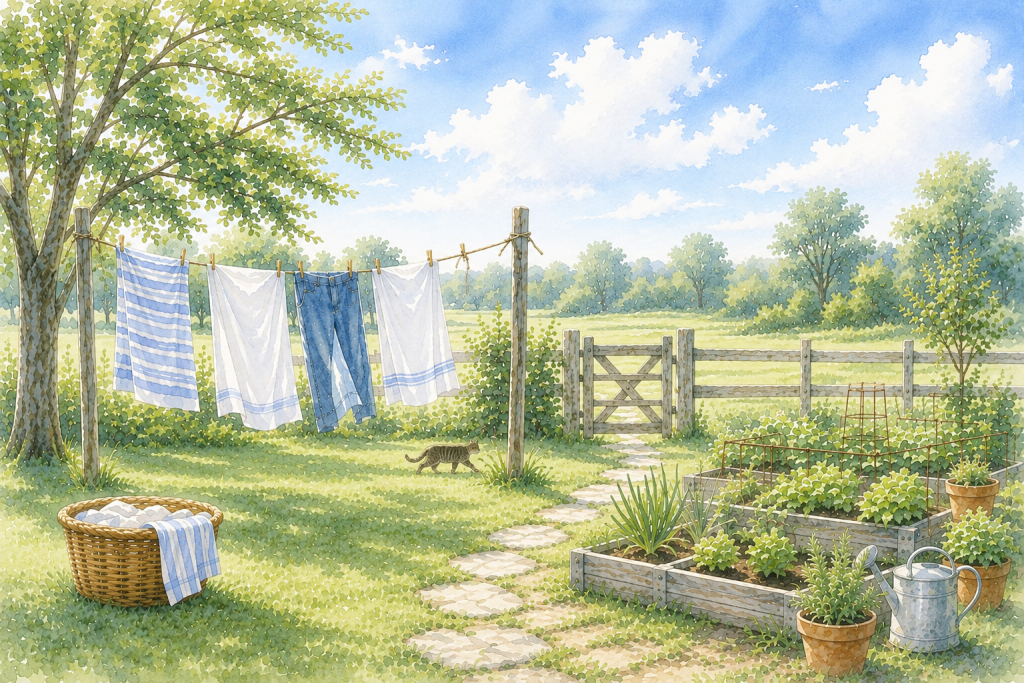
Mention living a simple life, and chances are a few familiar images come to mind. A garden growing behind the house. Bread cooling on the kitchen counter. Canning jars lined up in the pantry. Maybe chickens scratching in the yard, clothes drying on a line, or someone sitting in a rocking chair with absolutely nowhere they need to be for the next hour.
Those things can certainly be part of a simple life. I know. I’ve done most of them. But thankfully, they aren’t requirements.
You don’t have to live on a farm. You don’t need a garden large enough to feed the neighborhood or a pantry filled with food you preserved yourself. You aren’t required to bake your own bread, raise chickens, sew your own clothes, or give up every modern convenience you happen to enjoy.
A Simple Life isn’t something you assemble. It’s something you make room for.
And what you need to make room for may be entirely different from what I do.
That may be one of the most important things I’ve learned over the years. When I first began moving toward a simpler, more self-reliant way of living, I had plenty of ideas about what that life would look like. Some worked. Some didn’t. Others changed as I did.
At one point, I wanted wool sheep. It made perfect sense to me. I was a weaver, I wanted to learn to spin, and raising my own wool seemed like the natural next step. Then I did my research.
Wool sheep and Louisiana summers weren’t quite the partnership I had imagined. Technically, I suppose I could have built an air-conditioned barn, although my budget would probably have packed its own suitcase and left home. So I changed the plan.
I could still learn to spin. I could buy fleece. I could work with wool without raising the sheep that produced it.
The dream wasn’t wrong. It simply needed to fit the life—and the place—I actually had.
That’s one reason I hesitate when someone asks me how to live a Simple Life. I can tell you how I live mine. I can share things I’ve learned, mistakes I’ve made, skills that have served me well, and ideas you might want to try. But I can’t hand you a map with your route already highlighted.
Your starting point is different from mine. So is your destination.
Maybe you’re looking for more time with your family. You may want to become less dependent on convenience and learn how to do a few things for yourself. Perhaps you’re tired of buying things you don’t really need, or you’ve realized your schedule is so full that there isn’t much room left for anything you actually enjoy. Maybe you simply want some quiet.
Before deciding what a Simple Life should look like, it helps to ask why you want one in the first place. What are you hoping to make room for? That answer matters far more than whether you ever learn to can tomatoes.
Gardening, cooking from scratch, preserving food, handcrafts, frugality and old-fashioned skills are all wonderful parts of simple living if they have a place in your life. I enjoy many of them. There is satisfaction in looking at something and knowing your own hands helped grow it, cook it, repair it or create it.
But the tangible things are only part of the story. Some of the most important parts of a Simple Life can’t be put in a basket, stacked on a pantry shelf or crossed off a list. Contentment doesn’t come in a canning jar. Neither does peace.
You can’t knit extra time with someone you love, grow purpose in the garden, or bake breathing room into a loaf of bread.
But sometimes the choices we make about how we spend our time, what we own, what we learn, and what we’re willing to let go of create room for those things to grow.
That’s where simplicity begins to become something more than a lifestyle. It becomes your life.
And that life won’t remain exactly the same. Mine certainly hasn’t. There have been wrong turns, unexpected detours, plans that worked beautifully, and others that deserved to be abandoned somewhere beside the road. I’ve changed my mind. I’ve learned new skills and let others go. I’ve discovered things I thought I wanted and realized I didn’t need them after all. That’s allowed.
And let me remind you of something. Living a simple life doesn’t mean everything is going to be perfect. It can get just as messy as a hectic life. Things break. Money gets tight. Some days we need 36 hours instead of the allotted 24. The difference is, a simple life allows you to bend rather than break.
Living simply isn’t a test you pass. Nobody is standing at the end of the road with a clipboard checking whether you grew enough vegetables or made enough things by hand. And you don’t need anyone’s permission to begin.
Look at the life you have right now. What do you value? What do you miss? What would you like more of? What has taken up space that you would gladly give to something else?
You don’t have to answer every question today. You don’t need a five-year plan. And please don’t decide you have to change everything by next Tuesday. Turning Simple Living into one more enormous project rather defeats the purpose.
Choose a place to begin. Bake the bread if you want to. Plant three herbs in pots on a windowsill. Learn to mend a button. Turn off the phone for an hour. Sit outside after supper. Pick up the paintbrush you’ve been meaning to use. Make something with your hands. Spend an afternoon with someone you love and don’t accomplish a blessed thing.
Or simply give yourself enough quiet to figure out what you’ve been missing.
There will always be another skill to learn, another project to try and another mile of road ahead. That’s part of the fun.
You don’t have to be there yet.
You only have to start where you are.
