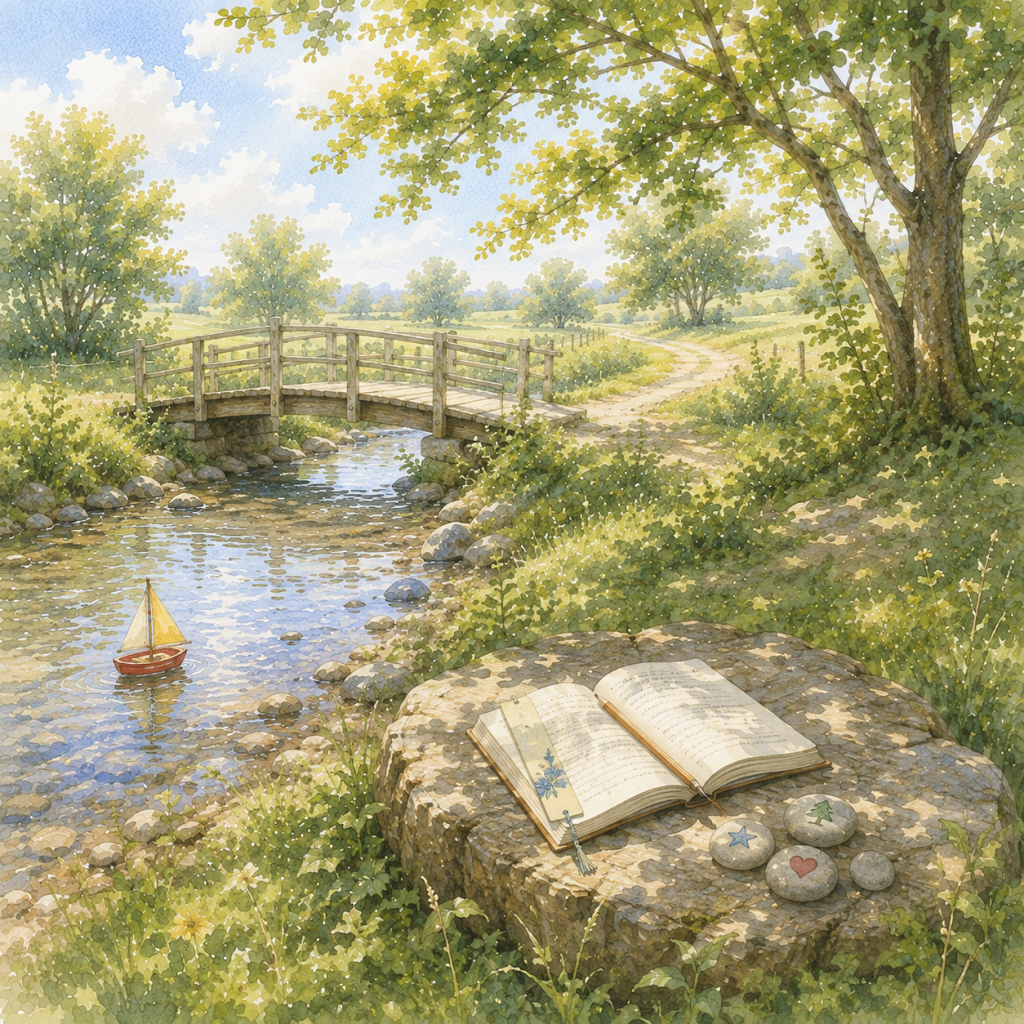
Every story has to start somewhere. Sometimes it’s a character who refuses to leave you alone. Sometimes it’s a place you can’t stop thinking about. Sometimes it’s nothing more than a strange little question:
What would happen if…?
And sometimes you just need a rock. Actually, three rocks.
Story Stones are a simple way to play with storytelling without worrying about outlines, plot twists, character arcs, or whether the whole thing makes sense yet. Each stone has a picture, symbol, or word on it. Toss them all into a bag, draw three, and see what your imagination does with them.
A key, a train, and a dog? Maybe the dog has the key. Maybe somebody left the dog on the train. Maybe the key opens something waiting at the last stop.
There are no wrong answers. There aren’t even any rules—although we’ll make a few up to get you started.
The best part about Story Stones is how versatile they are. You can play with them like a game of Solitaire, pulling stones and creating stories all by yourself. Having friends over for dinner and games? Put the stones on the table and see where the stories go. They’re also a simple way to spend time with the children in your life—and maybe even help them discover a love of stories and books along the way.

Make Your Story Stones
You’ll Need
- 15–20 smooth stones or wooden discs
- Acrylic paint, paint pens, or permanent markers
- Decoupage materials, stickers, or small paper images, if you prefer
- A small pouch, tin, basket, or box to hold your finished stones
Choose Your Story Pieces
Before you begin decorating, think about the kinds of things that make stories interesting. Try choosing a few from several different groups.
People & Characters
A child, grandmother, stranger, sheriff, baker, farmer, traveler—or even an animal.
Places
A house, farm, woods, small town, river, train station, garden, school, or shop.
Things
A key, letter, book, lantern, cake, suitcase, clock, hat, photograph, or cup.
Nature
A bird, flower, tree, moon, storm, sun, snowflake, or star.
Wild Cards
A secret, mistake, celebration, surprise, something lost, or an unexpected visitor.
Those are only starting points. Your stones should contain whatever makes you curious.
Make Your Stones
Give each stone one story element. Paint or draw a simple picture or symbol, write a word, add a small image with decoupage—or use a mixture of all three. Don’t worry about creating miniature works of art. If you know the squiggly blue line is a river, it’s a river.
Once everything is dry, put your Story Stones into their pouch, tin, basket, or box.
Now comes the good part.
Draw Three. Tell a Story.
Without looking, draw three stones. Put them in front of you. Now connect them.
You don’t have to write the story unless you want to. Tell it out loud. Tell it to your grandchildren. Take turns adding to it with a friend. Or sit there by yourself and see just how much trouble you can create with a key, a cake, and an unexpected visitor.
Your story can last two minutes or two hours. The only requirement is that somehow, somewhere, all three stones have to make an appearance.
Change the Rules
Once you’ve tried three stones, make up your own rules.
- Draw two and keep the story simple.
- Draw five and make things considerably more complicated.
- Let each person draw one stone and add the next part of the story.
- Tell a mystery.
- Make it funny.
- Try to use every stone in the bag.
- Draw one stone and tell a true story it reminds you of.
- Or choose one stone deliberately, then draw two more at random and see what happens.
- The point isn’t to write the next great American novel.
- It’s to play with a story and see where it goes.

Sometimes Simple Really Is Enough
It doesn’t take much to tell a story. A few rocks. A little paint. Some imagination. Maybe a friend or two sitting around the table.
Living a simple life isn’t necessarily about doing everything the old-fashioned way or giving up the things you enjoy. Sometimes it’s simply recognizing how much enjoyment can come from the ordinary things already around us.
The Farm Wife: Living a Simple Life on the Farm is filled with stories about finding that kind of life—not a perfect one, and certainly not one without its share of mishaps, but one where simple things still matter.
And really, if three painted rocks can keep a table full of people telling stories and laughing together, maybe we don’t need to make everything quite so complicated.